Posts

Week 13

Image
Disciple Leadership  "No one has learned the meaning of living until he has surrendered his ego to the service of his fellow man. Service to others is akin to duty, the fulfillment of which brings true joy." - President Thomas S. Monson How do we serve others best? Is it by listening to someone who is hurting? Is it by donating money or time to food shelters? Is it by being engaged in our family and invested in our relationships? Is community involvement the key? Visiting senior homes? Running businesses with fair wages and benefits? Caring for the environment? Investing in socially responsible businesses? Participating in microfinancing small business loans in developing companies? For me the answer to all the questions is YES. We have a responsibility to one another. We have a responsibility to help each other where and when we can. We are supposed to help each other in this life and if we are in a position to be giving, then we give. Jeffrey R Holland gave a great talk cal...

Week 12

Image
 Self-Sufficiency We hear about self-sufficiency often. When we are students, our education is meant to be a door to future self-sufficiency. When we are adults, paying our own bills and managing our finances is an assumed benchmark of our demonstration of self-sufficiency. We become independent as we leave home, and are responsible for maintaining our spiritual, social, and economic self-sufficiency. Sometimes we do better than others. Most of us rely on friends, family, organizations, or even governments when we are weak or experience a period of lack. Does that mean that we are not self-sufficient? By definition, yes. Dependence on someone or something else for something we cannot supply for ourselves is a lack of self-sufficiency. But, is that something that is a goal that we should be working toward, and helps along the way lead to that accomplishment in the end? If that is the case, should we be investing in one another to help develop mutual self-sufficiency as we progress t...

Week 11

Image
 IMPACT INVESTING Does how we invest our money really matter? Is it enough to know that our investments are making us money or is there more to consider? Enter-Impact Investing. The world's population of investors seems to be more aware of the needs of others and more interested that they use their money for good, especially if they are able to still make a profit on their investments. Impact investing does both. It allows financial resources to be used in ways that bring a social benefit while still having a return on the investment. This area of investing is a growing market as more and more individuals and companies recognize the importance of using their resources to positively impact the lives of their fellow man. This Ted Talk stood out to me. This is more than a trend and is impacting areas from environment to adequate childcare. What we do with our money matters, and we can become involved in social impact fairly easily by changing the way we invest to included Impact Inves...

Week 10

Image
  Hybrids and Social Businesses There seems to be a growing social consciousness in what consumers want from corporations. We want environmentally friendly practices. We are concerned about poverty and social issues. We want community support and decent wages with benefit packages. We want products that are responsible. Is this a lot to expect from businesses, or is it the wave of the future business model? For hybrid businesses, this is all part of their make-up. More than philanthropy, these social businesses integrate social impact into their models. They employ marginalized individuals,  invest in the communities they work in, create sustainable products and operating processes, and integrate social goals with their business practices. Every part of a hybrid's business model has social welfare combined with revenue generation. Hot Bread Kitchen impressed me this week. They make more than bread, they make breadwinners. Their business model partners workforce development, sm...

Week 9

Image
  Non-Profits and NGO's How are they organized? Why do we expect different things from them than businesses? How can they stay viable financially? These are important questions for socially conscious organizations to consider. Without a strong organization, the nonprofits tend to burnout and not have the impact they had hoped for. I have been involved with many non-profit organizations and have sat on the board of a couple. Without a strong organization, volunteer hours and well-wishes for a societal good will not deliver the results that you hope for. Photo credit: https://www.timberland.com/responsibility.html I am so impressed by Timberland's business model and the impact that Jeffrey Schwartz has had on this company. Business growth has been tied to values and has focused on community service, environmental responsibility and excellent products. This focus has allowed Timberland to grow to a global company with product sales in the hundreds of millions of dollars annu...

Week #8

Image
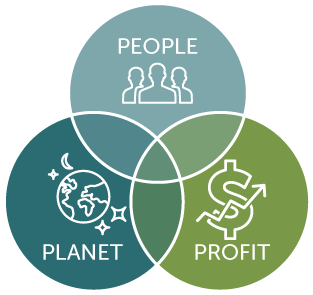
  Corporate Social Responsibility Does this matter to you? Do you base decisions to do business with companies based on the way they are socially responsible? This is an area that seems to be growing in the business world. Consumers, employees and shareholders are increasingly demanding greater social responsibility. Businesses have greater responsibility to the triple bottom line. This is not just profit, although that is obviously important to businesses. The triple bottom line includes economic, social and environmental considerations, Taking care of the planet by having environmentally responsible practices, take care of people by meeting social needs that relate to the business and find sustainable ways to have a profit while maintaining the other two areas is the goal of many modern businesses. One way that you can know if the companies you do business with are socially responsible is to check for a B Corp certification. This organizations certifies businesses who ascribe to ...

Reflection Journal #7

Image
 Business and Social Issues How do we address social issues? Is business important in addressing social issues? What business models are best in addressing social issues? These questions lead to more questions, but the reality is that a business model is developed to build a customer base and improve profit. Impact can be delivered in similar ways and business models like the lean start-up is extremely applicable to social issues. Lean start-ups get customer feedback from the start of their process and develops products based off customer input rather than starting with a business plan and product and then finding customers for the product. With social innovations, the customers are known, but the way to meet their needs are not always clear. Using the lean start-up model customer input can be used to help develop products that have true impact. This video shows how Bio Lite is innovating and how they have used lean start-up business modeling to impact lives across the world. https...

Reflection Journal #6

Image
  Capital, Money, Cash, Donations, Grants, Revenue How do non-profits and social innovators stay 'in business' and have the ability to pursue their mission? Money. Without the 'business' of getting money, it is very difficult to carry out missions to make social improvements. There are grants, loans and donations that may provide an influx of capital and help with reaching goals or providing services, but those are not always consistent or reliable. A business component that generates revenue will help social innovators fund their programs and continue their impact. image from skoll.org Vera Cordeiro is someone worth knowing about. In reading about her this week, I am struck by her tenacity, vision and the power of embroidered sheets. She saw a problem. As a pediatrician she treated patients who went home to unsanitary living situations and returned to the hospital for further care. She recognized that all the medical care she could provide would not heal children who d...

Reflection Journal #5

Image
  image from: https://www.beachcombingmagazine.com/blogs/news/the-starfish-is-not-a-fish Starfish hurling I have always liked the parable of the starfish about the child who is actively throwing starfish back into the ocean and when questioned about the difference he could possibly make considering the vast amount of starfish on the shore he replies that he made a difference to that one. I live near the Pacific Ocean and am well versed in tide changes, exposed starfish and the ecosystems that interact with starfish. I have never considered that hurling starfish into the sea to "save" them might actually be a negative thing. Are the ways that we help others productive or enabling? Do they disrupt natural consequences or cause problems that we did not foresee? Is the way I engage in community service the best use of my energy, time and talents or is it flinging things into the wide world thinking that I made a difference for whatever I removed from a situation and hurled into a...

Reflective Journal #4

Image
  DESIGN THINKING Empathize, Define , Ideate , Prototype , Test     Design thinking allows innovation when looking at social issues. Empathizing and understanding the people involved and effected by issues. Homelessness and poverty are not sterile abstract issues, they effect people and impact generational trajectories. Design thinking begins with empathizing and understanding the individuals involved and working to define problems through the lens of empathy and individual understanding. After empathizing and define, ideation and brainstorming can begin to come up with potential solutions. Prototyping a solution and testing are final steps that  are informed by the foundational design steps. This type of thinking allows for a true attempt to understand problems before proposing solutions. Erzsebet Szekeres Hungarian Social Innovator     I am so impressed by Ms. Szekeres and her ability to use design thinking to create innovation that effects an entire...

Reflective Journal #3

Image
     There are big problems in this world. Some are wicked problems that are so interconnected that it seems impossible to ever truly solve them. Things like poverty and homelessness have a multitude of root causes that contribute to the issues. Lack of education, illiteracy, substance abuse, mental illness...the list of factors to some social problems seems never ending. BUT  we can make a difference! Susan Matteucci! The story of her drive to make a difference, a life changing and generationally changing difference to an underserved, traditionally disadvantaged population where she lived has had impact in a huge way. You can learn more about SCC and what they do here: http://www.southwestcreations.com/ I am so impressed with how asking for volunteer sewers at a church meeting and then sewing three times a week in a church's room has grown to a multi-million dollar organization that supports women and their families as they provide employment and social support...

Reflective Journal #2

Image
  The main ideas this week centered on being the change in our communities and in the world. What does this mean to me?   What is my role? These are two of the questions that the materials studied this week tried to answer or inspire internal searching to answer. Martin Luther said that any work could be a calling if in was done in service to mankind. John Calvin stated that we are all endowed with talents and gifts with an imperative that we should use them to serve our fellow men.  There are many heresies that are associated with being the change, including that it can happen if we are lucky, there is only one true calling for each of us, that bliss will come from our calling, that we will get praise of the world or that work gives life meaning but these are not true. The goal with being the change is how can we do good-better, in a self-sustaining way that can be scalable and replicable?  Everyone can be a part of being a change. Finding ways to contribute and how...

Reflective Journaling #1

Image
       How do we solve the world's social issues? What can be done to find workable solutions to improving societies on a global level? How do we move from recognizing problems to enacting real change that impacts individuals and communities? Social Innovation.  Social innovation is finding new ways to address social issues in ways that change the society, not just individuals. This can be done in many different ways and from many different sectors. Governments, corporations, non-profit organizations and individuals can all facilitate social innovation as they work to help societies around the world. These different sectors can work collaboratively to enact lasting change. https://www.youtube.com/watch?v=3-20dnyLXKQ                This video talks about some of the projects that have come from students at the Ballard Center. It is an inspiring video because none of these people were in positions of power or wealth to initi...